
Meet the Bartlett Brothers: The Mascots Behind Canopy’s Values
If you’ve been following along with our blog, you already know that Canopy is rooted in a clear mission: helping good work grow. You’ve also seen the values that guide everything we do including service, honesty, grit, humility, curiosity, and collaboration.
But those values don’t just live in a list or a mission statement. We’ve found a simple way to make them easier to recognize in everyday work.
Meet our mascots, the Bartlett Brothers!
They’re a lighthearted part of our culture, but they reflect something real: the different mindsets that show up in community work, evaluation, and program leadership every day.
Pearcy: The Steady Guide
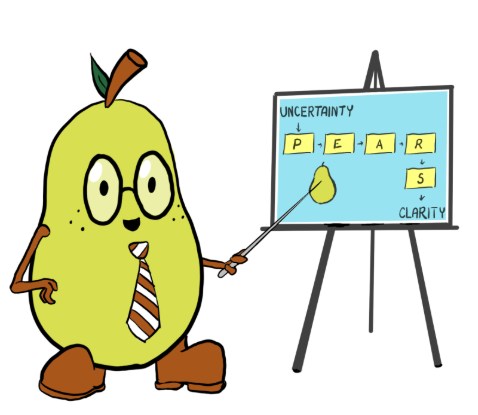
Pearcy (short for Percival) brings a sense of calm, perspective, and trust to the table. With his golden hue and round glasses, he’s easy to spot but it’s his approach that matters most.
Pearcy is the one who:
- Listens before jumping to solutions
- Offers steady encouragement
- Helps others reframe challenges as opportunities
You’ll see Pearcy’s mindset in action when:
- A team takes time to understand community needs before launching a program
- A partner conversation focuses on trust-building, not just deliverables
- Progress is measured thoughtfully, not rushed
Core values in action: Service & Honesty
Pearcy reflects the relationship-centered side of public service work, the part that requires patience, consistency, and a willingness to meet people where they are.
Perry: The Get-It-Done Builder

If Pearcy is the guide, Perry is the one who makes sure the work actually happens.
With his sturdy build, hard hat, and practical mindset, Perry represents follow-through. He’s focused, dependable, and not afraid to tackle what’s in front of him.
Perry is:
- Direct and motivating
- Focused on results
- Ready to step in and help
You’ll see Perry’s mindset when:
- A program gets implemented despite limited time or resources
- Reporting gets done (even when it’s not glamorous)
- Teams stay committed through long program cycles
Core values in action: Grit & Humility
Perry reflects the reality of day-to-day work by showing up, staying consistent, and doing what’s needed to move things forward.
Newton: The Curious Innovator

Then there’s Newton, the one asking questions, testing ideas, and looking for ways to improve.
With his lab coat and magnifying glass, Newton represents curiosity in action. He’s energized by learning and always looking a step deeper.
Newton is:
- Analytical and inventive
- Energized by new ideas
- Always asking “why?” and “what can we learn from this?”
You’ll see Newton’s mindset when:
- Teams use data to reflect on what’s working (and what’s not)
- Evaluation questions shape how programs are designed or adapted
- Partners collaborate to explore new approaches
Core values in action: Curiosity & Collaboration
Newton reflects the evaluation mindset of using information not just to report, but to learn, adapt, and strengthen impact over time.
Better Together: A Reflection of Real Work
Each of these perspectives shows up in meaningful work:
- Pearcy keeps the focus on people and relationships
- Perry keeps things moving and grounded in action
- Newton helps teams learn, improve, and adapt
Most of the time, effective programs require all three.
You might start with Pearcy, listening and building trust.
Move into Perry, implementing and following through.
And rely on Newton, asking questions and learning from the results.
That balance is at the core of strong community work. It’s also what tools like PEARS are designed to support, helping teams plan with intention, track their efforts, and learn from what they’re seeing along the way.
A Small but Meaningful Lens
The Bartlett Brothers are a simple way to name something many teams already experience: different strengths, different roles, and different ways of contributing to shared goals.
Sometimes you need to slow down and listen.
Sometimes you need to push forward and get it done.
And sometimes you need to step back and ask better questions.
Recognizing those moments and valuing each one is part of what helps good work grow.
Stay Connected
We’ll continue sharing tools, stories, and practical ideas to support your work in community engagement and evaluation.
If there’s a topic you’d like to see covered, or a story you’d like to share, we’d love to hear from you. Drop us a line at info@canopyteam.org!
Subscribe to our blog for an email when we post new content: