
Engagement vs. Outreach: Why the Difference Matters for the Carnegie Engagement Classification
If your institution is working toward the Carnegie Elective Community Engagement Classification, chances are you’ve heard the word “engagement” thrown around quite a bit.

But here’s the truth: engagement isn’t just a fancier way to say “outreach.” And understanding the difference isn’t just a matter of semantics, it could be the difference between meaningful transformation and missed opportunity.
So, What Is Engagement?
According to Carnegie, community engagement is built on mutual benefit, reciprocity, and co-creation.
It’s not something institutions do to communities, it’s something they build with them.
Think of engagement as relational, not transactional. It shows up as:
- Shared decision-making in program design and implementation
- Community members as co-educators and co-learners
- Ongoing feedback loops that honor community voice
Outreach Isn’t Bad – But It is Different
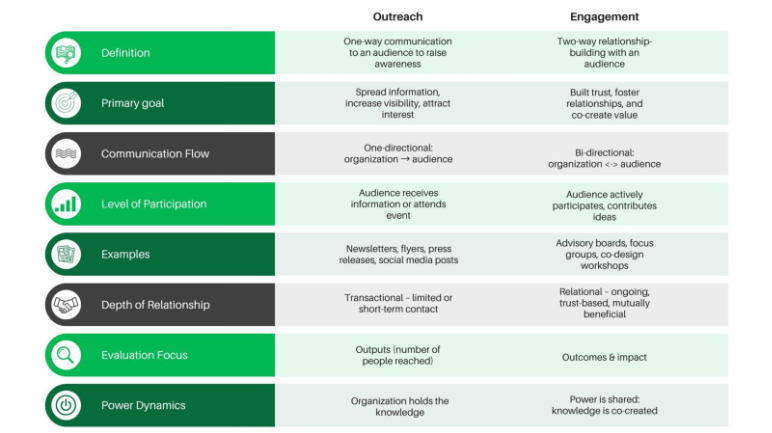
Outreach often looks like one-directional efforts: a campus-led tutoring program, a health fair, or faculty sharing research with the public. Valuable, yes, but usually planned and led by the institution, with little shared power.
Engagement, on the other hand, means building programs with communities, not just for them.
Here’s an example:
At one university, faculty initially designed a youth mentoring program on their own (outreach). After low participation, they restructured by inviting local educators and parents to co-design the curriculum and goals (engagement). The result? Higher participation, stronger trust, and more sustainable outcomes.
Why The Distinction Matters?
Because Carnegie is watching. And more importantly, so are your communities.
To earn (and keep) the Carnegie Engagement Classification, institutions must demonstrate that their engagement efforts are:
- Deep: grounded in high-quality, co-created processes
- Pervasive: embedded across departments, units, and roles
- Integrated: aligned with the institution’s mission, strategy, and academic priorities
If your approach is primarily outreach-based, it likely won’t meet the standard.
Engagement Signals Transformation
The Classification isn’t just a trophy. It’s a mirror.
Institutions that qualify show they’re not just dabbling in engagement, they’re structured for it. That includes:
- Offices or centers dedicated to community engagement
- Budget allocations for partnership work
- Systems (like CRMs or PEARS) to track and assess engagement efforts
- Feedback mechanisms where community partners’ voices truly shape decisions
The Bigger Picture for Your Campus
Engagement isn’t just about an application. It is about transformation that lasts:
- Stronger student learning and outcomes
- Greater public trust and relevance
- Clearer identity as a steward of the public good
And yes, it helps you stand out because not every institution is willing to invest in the relationships, reflection, and reciprocity that engagement requires.
Quick Takeaways
- Outreach is one-way, institution-led activity.
- Carnegie wants engagement. So do your communities.
- Engagement is shared power, co-creation, and long-term partnership.
What You Can Do Next
If your institution is working toward Carnegie recognition, or just want to deepen your institution’s public impact, start by asking:
- Are we listening to our partners?
- Are we sharing power and outcomes?
- Are our engagement efforts woven into the fabric of our institution or just pinned to the edges?
Want to go further? Subscribe to our blog for tools, stories, and strategies that help campuses like yours strengthen engagement practices. And if you’re exploring ways to track and report engagement efforts, checkout how PEARS supports institutions nationwide.
Subscribe to our blog for an email when we post new content: