
What is Program Evaluation (and How is it Different from Research)?
If you’ve ever found yourself scratching your head and wondering, “Wait, is this research… or is this evaluation?”, you’re not alone. The two are cousins in the world of inquiry: they share some family resemblance (methods, data collection, analysis), but they grow up to do very different jobs.
Both are about asking questions, gathering evidence, and learning something new. But while research is usually focused on building generalizable knowledge, program evaluation is focused on understanding and improving specific programs in real-world contexts.
Let’s take a walk through these differences together.
What is Program Evaluation? (Definition & Examples)
Program evaluation is essentially about learning in order to improve. It’s the systematic collection and analysis of data to answer questions about a program’s design, implementation, and outcomes.
Some of the most common evaluation questions include:
- Is the program reaching the people it was intended to serve?
- Are participants experiencing the changes we hoped for?
- What barriers are emerging during implementation?
- Is the program worth the investment of time and resources?
Evaluations are tied to real-world decisions. For example:
- A funder may need to know whether to renew a grant.
- A nonprofit director may be deciding whether to expand or adjust staffing.
- A university might want to know if a new student mentoring initiative is improving retention.
Think of evaluation as a mirror for programs. It reflects back what’s happening, so leaders can celebrate successes, identify gaps, and make informed changes.
What is Research?
Research, by contrast, is designed to create generalizable knowledge. The goal isn’t just to understand what’s happening in one program, but to generate insights that apply more broadly.
Research questions tend to sound like:
- What factors contribute to effective teaching across different contexts?
- How does social media use affect mental health in adolescents?
- What theories best explain how people adopt new technologies?
Unlike evaluation, research is less about immediate decision-making and more about advancing theory, contributing to a field, or testing scientific hypotheses.
Think of research as a telescope. It looks outward, reaching further to discover and build knowledge that extends beyond one setting.
A Quick Story to Illustrate
Imagine a community health clinic launches a new diabetes prevention program.
- An evaluation would ask: Is this specific program working for the people we serve? Are participants reducing their risk factors? Do we need to adjust our approach?
- A research study might ask: What are the most effective strategies for preventing diabetes across different populations? How does group-based education compare to one-on-one coaching?
Both perspectives matter, but they serve different purposes.
Key Differences Between Evaluation and Research
Here’s a side-by-side comparison to make it even clearer:
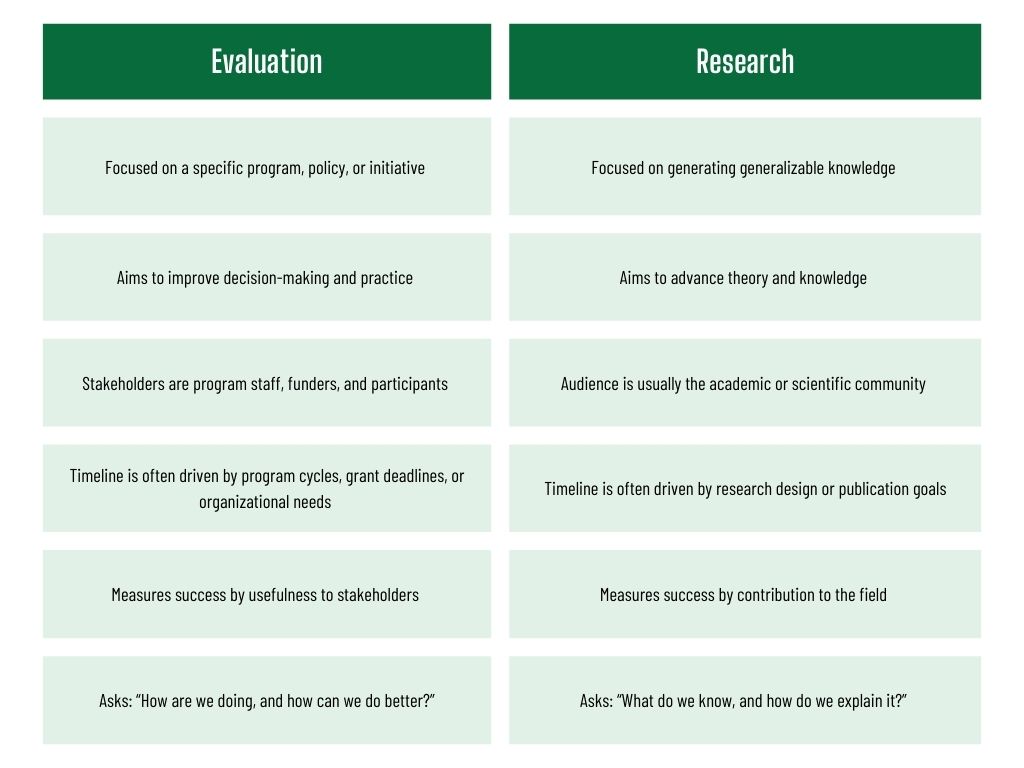
Where They Overlap
Evaluation and research are not mutually exclusive. They share important similarities:
- Both use systematic data collection methods (surveys, interviews, observations, experiments).
- Both rely on clear questions and careful design.
- Both aim to produce trustworthy evidence.
In fact, evaluations often borrow from research methods, and research studies sometimes use evaluation findings to guide future inquiry.
The key difference is purpose:
- Evaluation improves this program.
Research contributes to knowledge beyond the program.
Why the Distinction Matters
Keeping evaluation and research clear prevents frustration and misaligned expectations:
- Funders won’t expect evaluators to deliver sweeping generalizations.
- Program staff won’t feel pressured to meet standards that make sense in a research lab, but not in a community setting.
Evaluators stay focused on their central mission: helping programs learn and improve.
Why Both Matter
At the end of the day, both evaluation and research play vital roles.
- Research pushes the boundaries of knowledge and helps us understand big, complex issues.
- Evaluation grounds us in practice, ensuring that programs are effective, equitable, and responsive to the people they serve.
When these two cousins work hand-in-hand, the results can be powerful. Research offers big-picture insights, and evaluation shows us how those insights play out in specific, real-world settings.
Making Evaluation Doable
At Canopy, we know most folks don’t wake up in the morning excited to crunch data or write reports. You’re busy running programs, teaching, or working directly with your community. That’s exactly why we built PEARS. It’s a tool designed to make evaluation feel less like a chore and more like part of your everyday work.
With PEARS, you can capture what you’re doing, see the difference it’s making, and share that story with the people who need to hear it, whether that’s funders, university leaders, or your own community. It’s not about turning you into a researcher; it’s about giving you simple, meaningful ways to learn, improve, and celebrate impact.
Let’s Keep the Conversation Going
We’d love to hear from you: How do you use evaluation in your work?
Subscribe to our blog to get future posts on evaluation best practices or follow Canopy on LinkedIn for tips, stories, and resources.
Subscribe to our blog for an email when we post new content: